01 · HEALTH
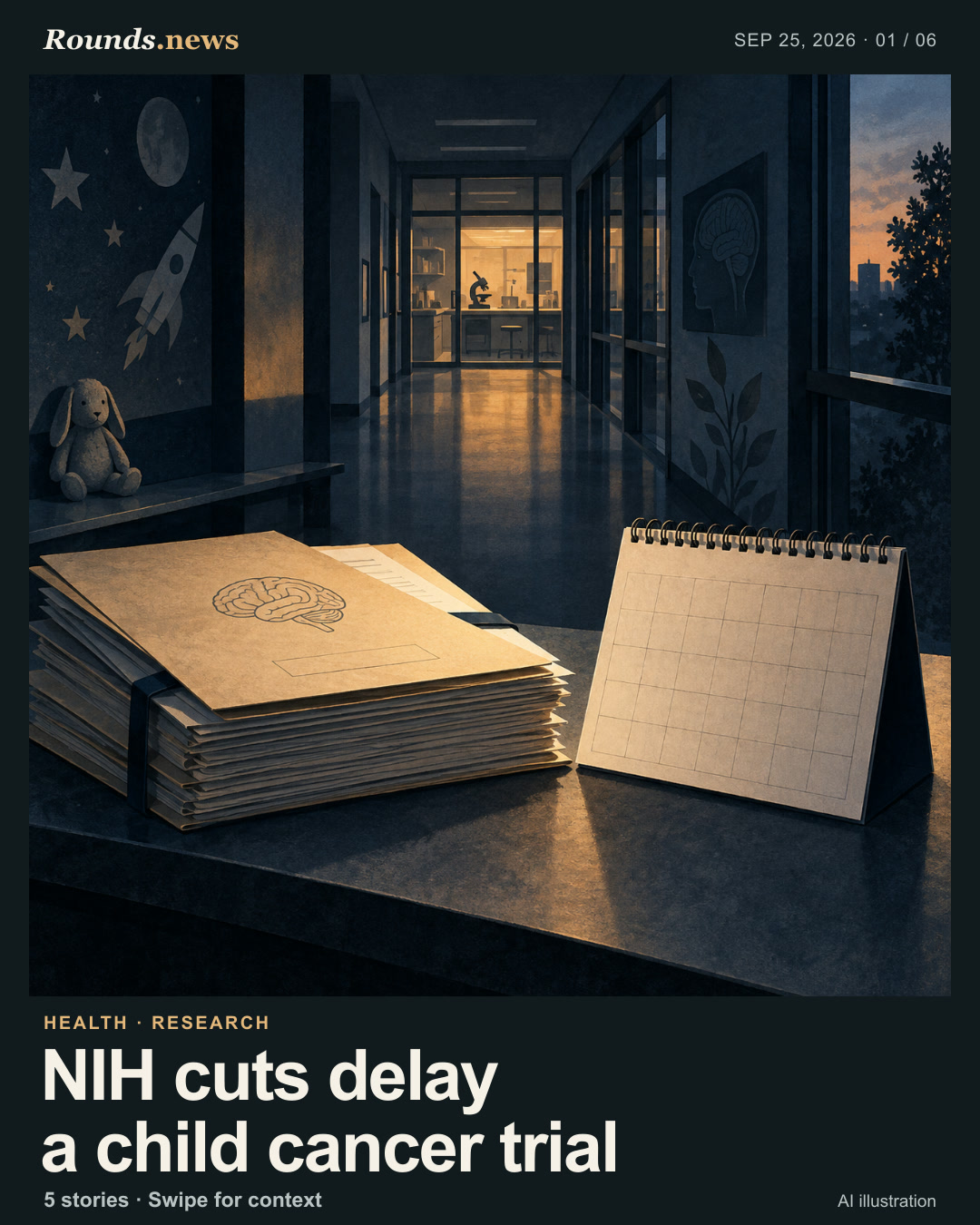
NIH funding cuts delayed a childhood brain-cancer trial
CNBC reports NIH funding cuts delayed a clinical trial for children with DIPG, a deadly brain tumor with few treatment options. The story follows one family; the delay does not establish whether the trial's treatment will help.
Why it matters: The account makes a time-sensitive research delay visible, while one family's experience cannot establish the national scale of the funding impact.
Read at CNBC ↗
02 · CULTURE
Dominic West and Sienna Miller discuss their new drama War
The Guardian interviews Dominic West and Sienna Miller about the eight-part legal drama War. They play a divorcing social-media billionaire and film star, and discuss money, public scrutiny and building sharply flawed characters.
Why it matters: The fictional marriage turns wealth and celebrity into story material; the interview distinguishes the characters from the actors' lives.
Read at Guardian Culture ↗
03 · SCIENCE
Research finds people underestimate how much waits vary
Phys.org reports a study finding that people often underestimate service-time variability, a bias researchers call overprecision. The paper says this can affect decisions about joining queues and how firms price or communicate waits.
Why it matters: Wait-time expectations shape choices, but the study examines a behavioral bias and service systems rather than every individual queue.
Read at Phys.org ↗
04 · TECHNOLOGY
Insta360 is exploring smart glasses and mirrorless cameras
The Verge says Insta360 has 73% of the global 360-camera market and is experimenting with mirrorless cameras and smart glasses as it looks beyond its core line. Those projects are exploratory, not announced product launches.
Why it matters: A specialist camera maker is testing adjacent categories, but the article describes development efforts rather than products already on sale.
Read at The Verge ↗
05 · TECHNOLOGY
Go 1.27 adds an experimental portable SIMD API
The Go Blog says Go 1.27 adds an experimental portable SIMD API after earlier architecture-specific versions. It aims to let Go developers write vector code that uses hardware acceleration where available and emulation elsewhere.
Why it matters: The design could ease high-performance programming across processors, but the API remains experimental and support differs by architecture.
Read at The Go Blog ↗