01 · SCIENCE
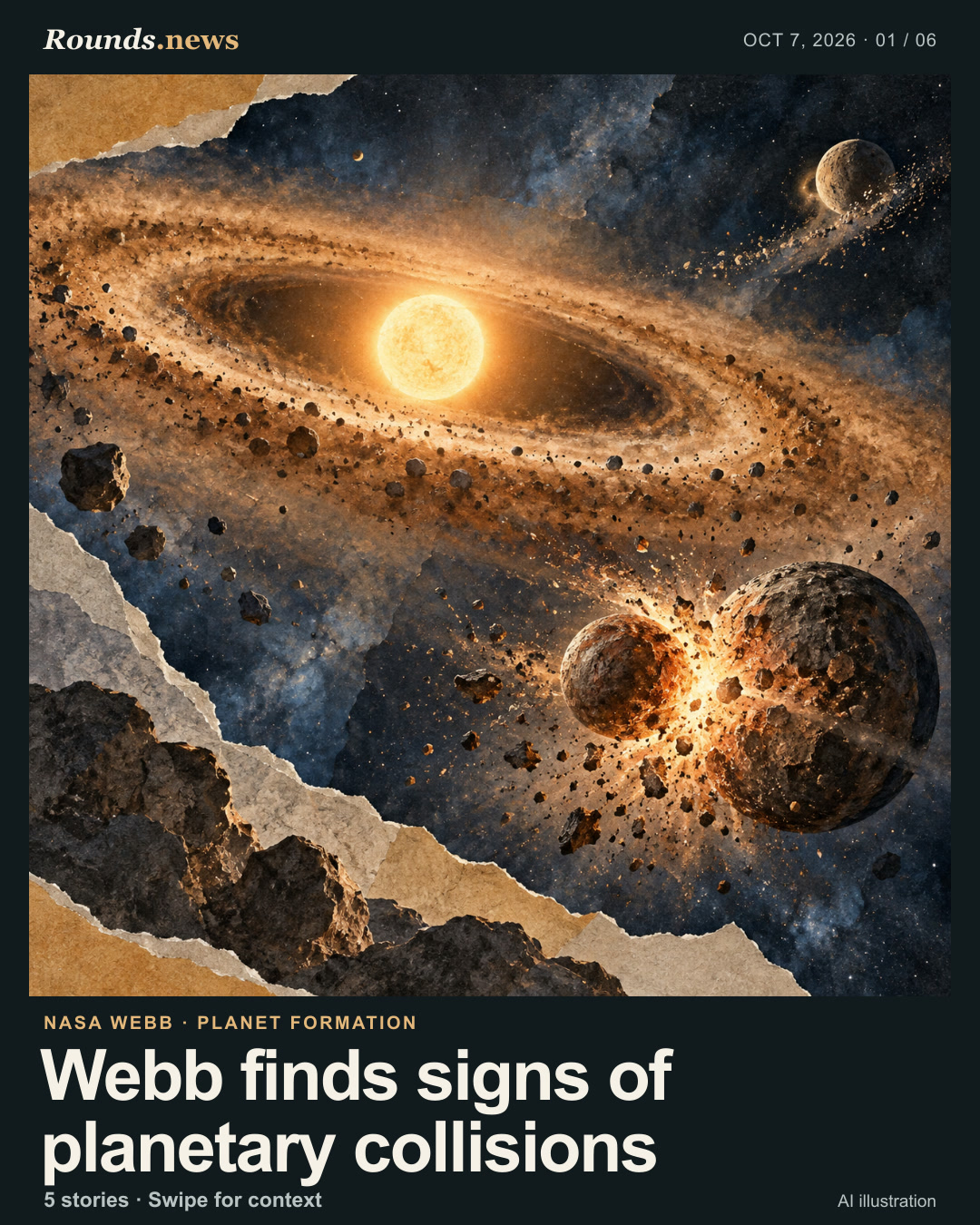
Webb finds clues to planetary collisions
ScienceDaily says Webb observations of 21 rare dusty disks around young stars may reveal the scale and energy of planetary collisions. The findings offer clues to rocky-planet formation; they are indirect evidence, not images of an impact.
Why it matters: The work uses debris to infer violent events in other systems; it does not show a collision live or prove how a particular planet formed.
Read at ScienceDaily ↗
02 · TECHNOLOGY
AI startup Tab emerges at $300m valuation
TechCrunch reports Tab emerged from stealth at a $300m valuation; the company withheld exact funding details. Its founders say users can message the assistant through iMessage or WhatsApp for tasks such as bookings and shopping.
Why it matters: The launch joins consumer-AI assistants promising to act for users. The valuation is reported; capabilities are described by the startup.
Read at TechCrunch ↗
03 · BUSINESS
U.S. panel alleges Webull China ties pose data risks
CNBC reports a bipartisan House committee alleges Webull's China ties could expose customer data. Webull disputes the report, saying its U.S. operations and customer data are domestic and the findings are inaccurate.
Why it matters: The dispute puts financial-data flows under scrutiny. The risk claim is a committee finding, not adjudicated fact, and Webull rejects it.
Read at CNBC ↗
04 · SPORTS
Study finds pink cricket balls harder to see for some
Phys.org reports a study found cricketers with color vision deficiency can struggle to track pink balls at dusk or against grass and crowds. The ICC approved a trial of pink balls in low-light Tests only when both teams agree beforehand.
Why it matters: The study flags visibility concerns for some players in certain conditions, not every player or match.
Read at Phys.org ↗
05 · CULTURE
Why music is never quite ‘pure’
A Guardian culture essay argues musical techniques are shaped by human history and context. It links Steve Reich’s tape pieces, built from recorded voices, with Hannah Kendall’s music, which engages with histories and systems of power.
Why it matters: The essay challenges the idea of music as separate from the people and histories that shape it. This is the writer’s interpretation of the composers’ work.
Read at Guardian Culture ↗